New research: Regulated textile product stewardship in Aotearoa could add $602 million to the economy
Imagine a thriving textile and fashion sector in Aotearoa New Zealand where a level playing field exists for all businesses, affordable clothing remains accessible for everyone, and circular economy design practices create more jobs.
New research by Eunomia Regulated Product Stewardship for Textiles in Aotearoa New Zealand, a cost benefit analysis (CBA), that was commissioned by the Textile Advisory Group with funding from Clare Foundation, shows this future is not only possible but economically beneficial. Regulated product stewardship (RPS) is the foundation of a resilient, fair and thriving textile industry in Aotearoa New Zealand, says Textile Advisory Group spokesperson Bernadette Casey. “RPS supports a stable textile industry in Aotearoa New Zealand and this is especially important in times of uncertainty” Casey says. “We now have research that shows the economics of RPS not only stack up but could bring significant benefits to Aotearoa New Zealand.”
The report outlines two regulated product stewardship pathways, a modest and a high‑ambition option. It estimates a net benefit of $98m over ten years under the modest scenario, increasing to $602m under the more ambitious approach. Both options would also deliver significant environmental and social benefits for the sector and Aotearoa New Zealand.
RPS for textiles would generate funding for research and circular design, infrastructure and systems for reuse and recycling, and consumer education campaigns. A high ambition scheme would go further with kerbside textile collection, digital product passports, and would result in significantly higher reuse and recycling.
Key findings include:
● A $98 million net benefit under the modest RPS scenario and a $602 million net benefit for the high ambition scenario. ● Employment could grow by up to 6% by 2038. With opportunities across repair, reuse, recycling, research and innovation, and consumer engagement. ● Currently, 78% of textiles end up in landfill (107,000 tonnes/year), with just 6% reused or recycled in New Zealand. ● Under a high ambition RPS scheme, landfill could fall to just 4% by 2038, with a 23% reduction in consumption, and 86% of what is bought, reused or recycled. ● For regular (mid-price) fashion items, price would increase by 1.8% on a modest ambition scenario and 2.9% for high ambition RPS. ● For super fast-fashion, the retail price would increase 7% and 11% under the different scenarios (for a $25 top this would be a $1.80 or $2.90 increase respectively). Properly funded reuse (e.g. hire/lease) and repair initiatives, meanwhile, would improve access to good quality clothing. ● Carbon emissions could be reduced by up to 10.8 million tonnes by 2038, with carbon reduction benefits valued at $900 million under the low ambition scenario and $1.6 billion under the high ambition.
A well‑designed RPS would introduce compliance and funding obligations for producers, with most costs falling on low‑quality imports. However, the research shows the overall benefits outweigh these costs by reducing pressure on local councils’ waste systems, increasing the value of recycled materials, and creating new revenue streams for New Zealand businesses.
Eco‑modulated incentives are a key part of RPS and reward producers for improving durability, repairability and recyclability. Incentivising better product design encourages investment in durable and repairable textiles, as well as in reuse. Consumers, while potentially paying a little more up front, would benefit from higher quality products that deliver better value for money over time.
RPS is the foundation for a strong local textile industry where businesses compete on quality rather than volume; and responsible production supports investment in innovation, textile recycling and circular business models, resulting in increased value for all.
In May 2025, Parliamentary Commissioner for the Environment (PCE) published the research note ‘Resource use and waste generation in Aotearoa New Zealand: filling (some) gaps’ to contribute to the investigation they’re carrying out on the impacts economic production and consumption impart on the environment. The investigation seeks to gather information about whether continued population and economic growth can be sustainable with finite natural resources and absorptive capacity for waste and pollutants. The research note summarises five pieces of external research commissioned by PCE to fill in data gaps identified in their literature review that centred around resource use and waste generation in New Zealand.
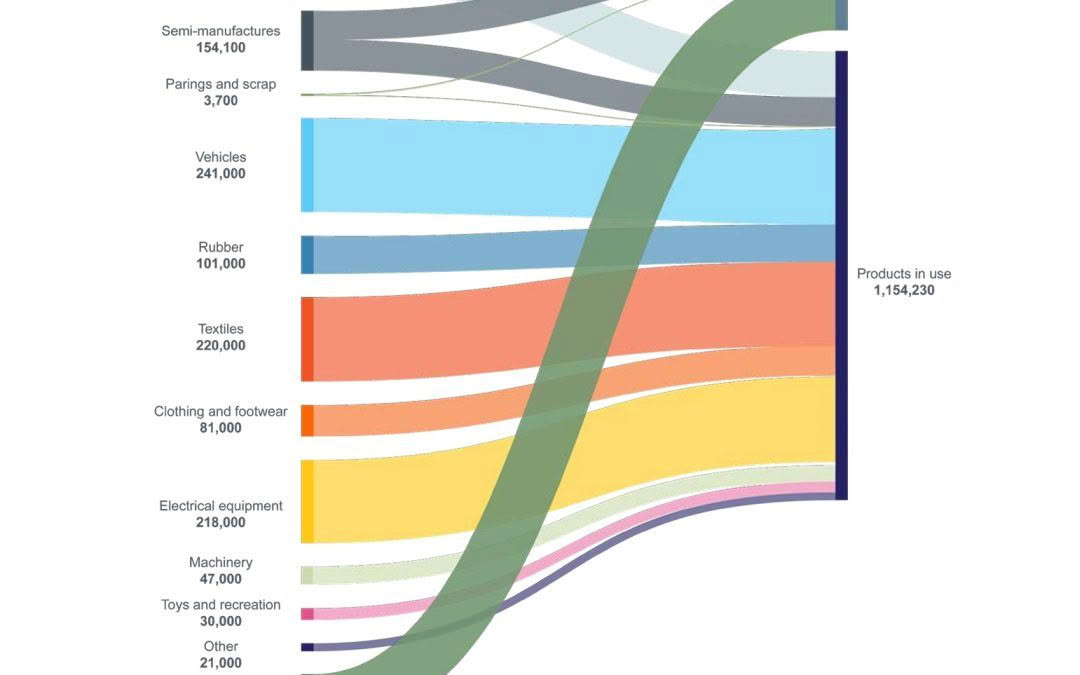
One of the external research pieces, ‘The plastic content of manufactured imports’ was undertaken by Eunomia Research & Consulting alongside Whirika Consulting. This research focussed on quantifying New Zealand’s plastic problem and mapping the flows of plastic. Two key findings identified in the research note are outlined below: Key finding #1: There is far more plastic in complex products than in packaging. Key finding #2: The largest components of New Zealand’s plastic use – vehicles and textiles – are also key sources of microplastics.
Click here to find out more about PCE’s investigation into resource use and waste generation, and to read a summary of our report on page 48.
“Measuring the amount and types of plastic we use and discard is a prerequisite for appropriate management and monitoring – it is a vital step in allowing us to make evidence-informed decisions around where we direct resources to improve our use and management of plastic, and to track their effectiveness.” – Professor Dame Juliet Gerrard (previous Prime Minister’s Chief Science Advisor)
Consultant Anita Lewis presented a webinar hosted by WasteMINZ on the 9th October 2024. Titled ‘Invisible Waste: Unveiling Microplastic Pollution’, Anita discusses the pervasive issue of microplastics. Focusing on its sources, environmental impacts, and the role of the waste management sector in mitigation and management.
Anita highlights the significant contribution of microplastics from textiles, the far-reaching consequences for ecosystems and human health, and the ability of microplastics to spread across the globe, including remote locations like Antarctica.
Anita discusses solutions including improving wastewater treatment technologies, policy changes, and shifting to the circular economy for textiles and plastics in particular. Other ways to reduce microplastic pollution include increasing industry accountability and public awareness.
In September 2024 Eunomia produced a report for Waikato Regional and Tauranga City Councils that seeks to understand what place waste to energy has in Aotearoa.
The report presents outcomes on key waste to energy technologies and their potential application in New Zealand, and Waikato and Tauranga specifically. The study compares greenhouse gas emissions of four scenarios where three use WtE technologies and one uses landfill as the status quo.
Ever wondered where the rubber on your tyres goes when it wears off? Eunomia Senior Consultant Dr Chiarina Darrah took part in a panel discussion on the problem of microplastics from tyre wear at this year’s Fully Charged Live.
The festival of clean energy technologies and electric vehicles took place over 7th–9th June at Silverstone, UK. Fully Charged is a YouTube channel exploring electric vehicles and renewable energy, hosted by writer, broadcaster and actor Robert Llewellyn and Jonny Smith.
Chiarina appeared on Sunday 9th in a session titled ‘What you need to know about particulate & tyre pollution’. She drew on our work on emissions of microplastics into the environment to discuss the scale of the problem, potential policy solutions and what consumers can do to help. The panel was chaired by physicist, oceanographer and broadcaster Helen Czerski, and also featured Richard Lofthouse of Emissions Analytics, independent specialists for the measurement of real-world emissions, and G Erlendsson of Enso Tyres, a manufacturer of sustainable tyres for electric vehicles.
Darebin City Council (DCC) in Melbourne,
Australia were the first in the world to declare a climate emergency in
December 2016.
We have been appointed to help the council to determine what practical actions they can take to meaningfully reduce the amount of carbon that they currently emit through their waste management practices. We are working with our UK office, as well as Australian engineering consultancy Irwinconsult.
As a result of the declaration, the council
has produced a Climate Emergency Plan, which outlines the objectives and
actions that DCC will take to reduce their contribution to climate change. Our
work with DCC addresses Key Direction No. 5: Consumption and Waste
Minimisation. The aim of this directive is to reduce the amount of waste to
landfill, including food waste and recycling.
Our team are working with DCC to examine the practical steps that they can take to reduce their carbon emissions from waste. This involves carrying out an assessment of the area’s current emissions, as well as evaluating the potential effectiveness of a range of options, including the potential for Energy from Waste and the use of biochar.
Since Darebin’s declaration, local
authorities across the world have taken similar action, with dozens of councils
having currently declared climate emergencies in the UK alone.
In advising the DCC, our team is drawing from its considerable track record in this area, which includes the development in 2010 of the ground-breaking Greenhouse Gas Emissions Performance Standard (EPS) for the Greater London Authority (GLA). Work for the GLA currently includes the provision of support to London boroughs to ensure that they comply with the EPS, as well as the development of progress updates on London’s performance against the standard.
You can download a presentation referring to our work here:
In the course of our work we talk to lots of council members, stakeholders, and members of the public. The topic of Waste to Energy comes up regularly. Waste to Energy is common in many places overseas such as UK, parts of Europe, Japan, and it is becoming more common in China and the USA. But New Zealand doesn’t have any Waste to Energy facilities that process municipal waste. In this article for Revolve magazine Dr Dominic Hogg and Duncan Wilson examine the pros and cons of burning waste to generate energy.
Eunomia Research & Consulting undertook research to improve understanding of the impacts of possible changes to the structure and rate of the Waste Disposal Levy.
The study, which was commissioned by a consortium of businesses and councils, showed that there are likely to be real benefits for NZ through putting in place a well-structured levy regime. The research found there would be significant benefits in terms of waste minimisation, employment, and the economy. Key features should include:
Extending the levy to all types of fills
A large increase in the rate of the levy
A differential between ‘active’ waste and ‘inert’ waste
This report, from Eunomia UK, highlights the potential for a measures-based approach to be more effective at tackling marine plastic litter than setting targets.
Marine plastics are an emerging issue facing policy makers. However, the information we currently have on the impacts of marine plastics is limited. This makes it challenging to identify what a ‘socially optimal’ level of marine plastic pollution would be. The lack of information seems to be encouraging a wide spectrum of policy responses, which range from a complete ban on many kinds of plastic at one extreme, to “do nothing until we’ve improved our data” at the other.
This document reflects upon the data challenge and explains why detailed monitoring of marine litter is difficult, expensive and ultimately, perhaps, unnecessary. It argues that setting reduction targets for marine plastics is unlikely to be effective policy. Instead, it proposes a “Best Available Technique” approach to the selection of measures, similar to the way in which industrial emissions are addressed.
This report is available free of charge. Press the button below to download.